
How to Get a Restraining Order Dismissed in NJ
How to Fight a Restraining Order in New Jersey
 The knock comes without warning. You open the door to find a police officer holding papers—a temporary restraining order. Within minutes, you’re being told to leave your home. You can’t contact certain people. One wrong move could mean jail time. Everything you thought was stable just collapsed.
The shock hits first, then the embarrassment. Maybe anger. You want to explain yourself and present your side, but no one is asking yet. Right now, all that exists is a piece of paper with accusations you might not even recognize as true. It’s easy to panic. Most people do.
Can a Temporary Restraining Order Be Dismissed in New Jersey?
But here’s what many people don’t realize: temporary restraining orders get dismissed every single day in New Jersey courts.
A TRO—a temporary restraining order—is exactly that: temporary. It’s issued quickly, often without the accused person even being present to respond. The real fight happens later, at the final restraining order hearing. That’s when a judge will actually examine the evidence and decide whether the accusations meet New Jersey’s legal definition of domestic violence.
Until that hearing, nothing is decided. And the burden of proof? It’s entirely on the person who filed against you.
If they can’t prove their case—if they can’t show that domestic violence actually occurred and that they genuinely need protection—the judge must deny the restraining order. When the evidence doesn’t support the claims, temporary orders get dissolved. It happens more often than you’d think.
Consequences of a Final Restraining Order in New Jersey
Why Final Restraining Orders are Permanent (and devastating)
If a final restraining order is issued, the consequences do not last only a few months. In New Jersey, FROs are permanent. They stay on your record indefinitely.
You’ll be fingerprinted and entered into the state’s domestic violence registry. Your firearms? Gone—immediately and permanently. The court can fine you up to $500. But the financial penalty is honestly the least of your concerns.
An FRO can cost you your job. Certain professional licenses become impossible to maintain. Landlords can deny you housing. If you’re not a U.S. citizen, it could derail your immigration status—even if you’ve been here legally for years.
All of this can happen after a single court appearance—no criminal conviction required. You could have a completely clean record and still lose access to entire parts of your life. That’s why fighting this isn’t optional. The stakes are too high to go in unprepared.
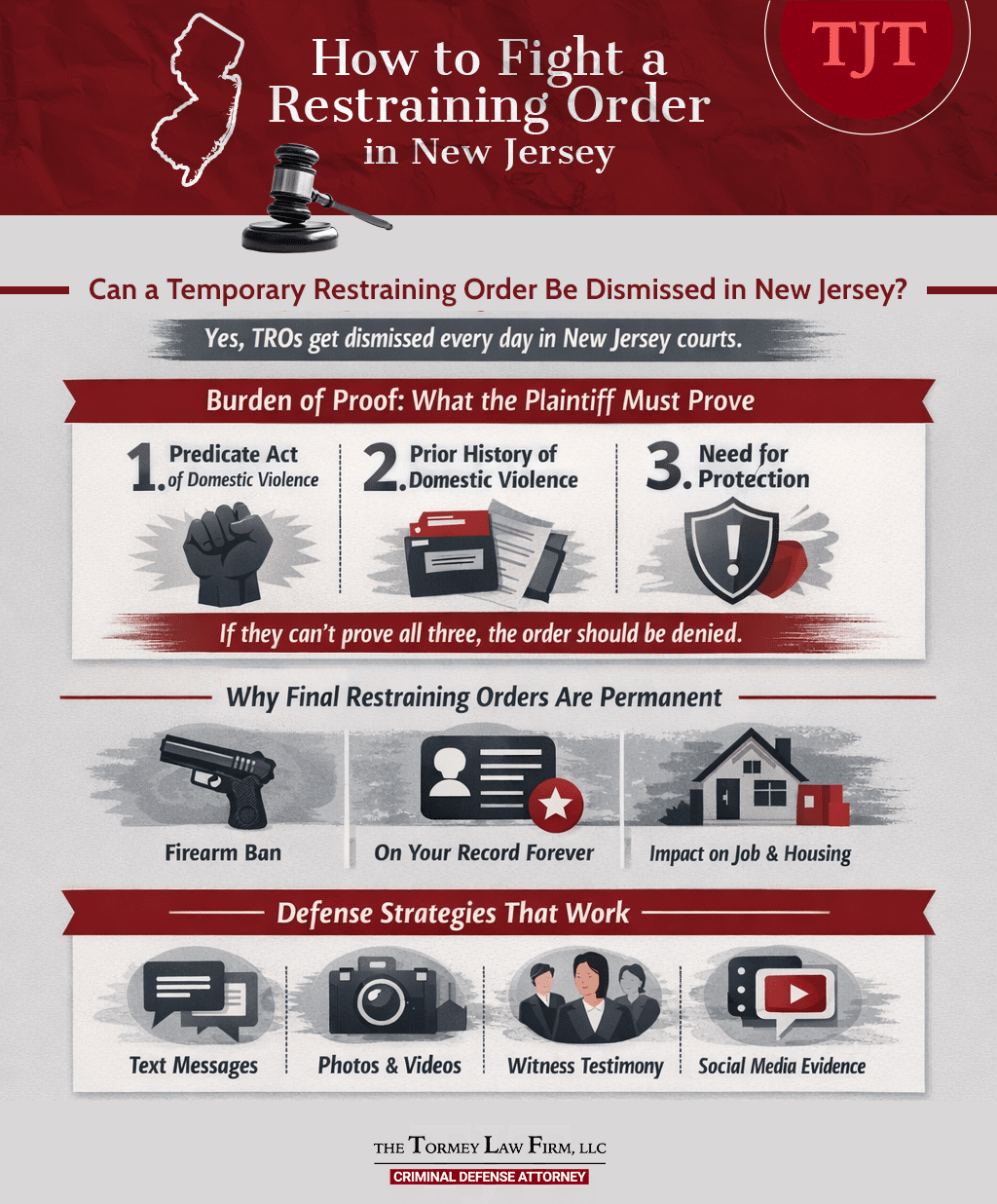
View full infographic: NJ restraining order defense strategies
Should I Hire a Lawyer for a Restraining Order Hearing?
The time between receiving a TRO and your final hearing is short—usually about ten days. That’s not a lot of time to figure out court procedures, gather evidence, and prepare your defense.
A restraining order lawyer doesn’t just show up to court with you. They start working the moment you’re served.
First, they’ll break down what’s actually being claimed. Legal documents are written in a way that’s deliberately confusing if you’re not used to reading them. Your attorney translates that into plain language so you understand exactly what you’re up against.
They’ll also outline what will happen at the hearing and what the judge will ask. What you should and shouldn’t say. How to stay calm under cross-examination. How to avoid giving answers that sound defensive or evasive, even when you’re telling the truth.
Because here’s the thing: being honest isn’t enough. You need to be clear, concise, and credible. That takes practice.
Your lawyer will also help you pull together evidence—text messages, emails, photos, and witness statements. They’ll know what’s admissible in court and what isn’t. They’ll help you organize it so the judge can actually follow your story instead of drowning in a pile of screenshots.
And if the other side’s story has holes in it—and it often does—your attorney will find them. They’ll know how to cross-examine the plaintiff without coming across as hostile or aggressive. They’ll raise the right objections at the right time. Most importantly, they’ll use that ten-day window efficiently. Because once you’re standing in front of the judge, there’s no do-over.
What Does the Plaintiff Have to Prove in a Restraining Order Case?
The Legal Framework: What the Plaintiff Has to Prove
New Jersey courts follow a three-part test derived from the case Silver v. Silver. For a final restraining order to be granted, the plaintiff has to prove all three elements. If even one falls short, the order should be denied. Let’s break them down.
Element #1: A Predicate Act of Domestic Violence
This means the plaintiff has to show that you committed a specific act that’s listed in New Jersey’s Prevention of Domestic Violence Act (N.J.S.A. 2C:25-19).
The statute covers things like assault, harassment, terroristic threats, stalking, criminal mischief, false imprisonment, sexual assault, and a few others.
Notice what’s not on that list: yelling. Being rude. Having an argument. Saying something hurtful.
Those things might make someone upset, but they’re not domestic violence under the law. The plaintiff has to prove you did something that fits one of the specific categories in the statute. Anything less, and the first element isn’t met.
Element #2: Prior History of Domestic Violence
The court does not look at just one incident. They want to know if there’s a pattern.
Has this happened before? Are there prior police reports, prior restraining orders, prior arrests? Have there been other incidents that didn’t result in legal action but still show a history of abuse?
Witnesses can testify about past behavior. Old text messages or emails might come into play. The judge is trying to figure out whether this is an isolated argument or part of something bigger. A single incident—especially one where the facts are disputed—often isn’t enough on its own.
Element #3: The Plaintiff Needs Protection
Even if the plaintiff can prove that a domestic violence act occurred and that there’s a history, they still have to show that they’re in danger now.
This isn’t about whether they’re upset or hurt. It’s about whether they have a reasonable fear for their safety going forward.
The judge will look at the severity of the past conduct, whether threats were made, and whether there’s any indication that violence could happen again. A one-time argument where nobody got hurt and no threats were made? That’s usually not enough to justify a permanent restraining order.
Fear must be based on something real, not merely on emotional discomfort or anger. If any one of these three elements is missing or weak, the plaintiff’s case falls apart. That’s where a strong defense makes all the difference.
How to Defend Against a Restraining Order: Evidence That Matters
Restraining order hearings come down to facts. Not feelings, not who tells a more emotional story—facts.
The plaintiff will present their version of events. Your job is to show that their version either isn’t true or doesn’t meet the legal standard for a restraining order. That means evidence. Lots of it.
Using Text Messages as Evidence in Restraining Order Cases
These are gold in restraining order cases. Why? Because they can’t be misremembered or exaggerated. The conversation is right there, word for word.
If the plaintiff claims you sent threatening messages, the texts will either back that up or prove it didn’t happen. If they claim you were harassing them, but the messages show they were the one initiating contact, that’s a problem for their case.
Context matters too. A single angry text might look bad in isolation, but if the full conversation shows it was part of a mutual argument—or that the plaintiff responded calmly afterward—it changes the picture.
Photos and Videos as Defense Evidence
A photo showing the plaintiff smiling and posting on social media the day after they claim they were terrified? That raises questions.
Video footage showing what actually happened during an alleged incident? Even better. If the plaintiff claims property was damaged, photos of the supposed damage (or lack thereof) can be critical. If they claim they were injured, but there are no visible injuries in photos taken around that time, that’s worth noting.
Can Social Media Be Used Against You in Court?
People forget that their social media is public. Posts, check-ins, comments—they all create a timeline. If someone claims they’re living in fear but posts photos at parties or tags themselves in public places, that undermines their credibility.
Witness Testimony in Restraining Order Hearings
Friends, family, neighbors, coworkers—anyone who saw or heard what happened can testify. Sometimes a neighbor overheard the argument and can confirm that it was mutual, not one-sided. Sometimes a friend was there when the alleged incident occurred and can provide a completely different version of events.
Witnesses are especially useful for establishing patterns of behavior. If the plaintiff has a history of making false accusations, or if there’s evidence they filed the restraining order for strategic reasons (like getting an advantage in a custody dispute), witnesses can speak to that.
Challenging Credibility in Restraining Order Cases
In a restraining order hearing, the judge has to decide who to believe. Often, it’s one person’s word against another’s. That’s why credibility is everything.
If the plaintiff’s story has inconsistencies—if they said one thing to the police and something different in court, or if their testimony doesn’t match the evidence—the judge will notice.
Cross-examination is where those inconsistencies come out. A skilled attorney knows how to ask questions that expose contradictions without being aggressive or disrespectful.
Sometimes, the motive behind the restraining order becomes clear during cross-examination. Is this really about fear, or is it about anger? Is it about safety, or is it about gaining leverage in a divorce or custody case? Judges see restraining orders used as tactical weapons all the time. They know the signs. If the plaintiff’s fear doesn’t seem genuine, or if their story keeps changing, the judge will take that into account.
Who Has the Burden of Proof in a Restraining Order Case?
Here’s something a lot of people don’t understand: you don’t have the burden of proof. The plaintiff does. That means you don’t have to prove you didn’t do anything wrong. You just have to show that the plaintiff hasn’t proven their case.
Maybe their evidence is weak. Maybe their witnesses aren’t credible. Maybe their story doesn’t add up. If the judge has reasonable doubt about any of the three elements—the predicate act, the history, or the need for protection—the restraining order should be denied.
This is a civil proceeding, not a criminal trial, but the stakes are just as high. You need someone in your corner who knows how to poke holes in the other side’s case and present your defense effectively.
What to Expect at a Final Restraining Order Hearing in NJ
The hearing typically occurs about 10 days after the TRO is issued. It takes place in the New Jersey Superior Court, Family Division, in front of a judge. There’s no jury.
The plaintiff goes first. They’ll testify, submit evidence, and possibly call witnesses. After they’re done, the defendant gets a chance to cross-examine them and their witnesses.
Then it’s the defense’s turn. You can testify if you choose to. You can submit evidence—texts, emails, photos, whatever supports your case. You can call your own witnesses.
After both sides present their case, the judge makes a decision. Often, the ruling comes the same day. Even though these hearings move quickly, they follow formal court rules. Evidence has to be admitted properly. Witnesses have to be questioned correctly. Objections have to be raised at the right time.
If you don’t know what you’re doing, you’ll miss opportunities to challenge the plaintiff’s case. You’ll submit evidence the wrong way, and it won’t get considered. You’ll answer questions in a way that hurts your case without realizing it. That’s why preparation matters. And that’s why you don’t walk into that courtroom alone. Sometimes, the case gets dismissed on technical grounds before you even get to the facts.
For a court to issue a restraining order, it has to have jurisdiction. That means the case must be filed in the correct county. Generally, that’s either the county where one of the parties lives or the county where the alleged incident happened. If the plaintiff files in the wrong place, the court doesn’t have authority to issue the order.
Who Can File a Restraining Order in New Jersey?
 Not just anyone can file for a restraining order. You have to have a specific relationship with the person you’re filing against.
Under New Jersey’s domestic violence law, which includes:
- Current or former spouses
- People who are dating or have dated
- People who live together or have lived together
- People who have a child together
If the plaintiff doesn’t fit into one of these categories, they don’t have standing to file under the Domestic Violence Act. The case should be dismissed. Sometimes, plaintiffs stretch the definition of “dating” or “living together” to fit the statute. If the relationship doesn’t actually meet the legal standard, that’s a defense.
FAQ About Fighting a Restraining Order in NJ
Can a restraining order be dismissed in NJ?
Yes. Temporary restraining orders get dismissed every day in New Jersey courts. If the plaintiff fails to prove all three required elements—a predicate act of domestic violence, a history of abuse, and a genuine need for protection—the judge must deny the final restraining order. The burden of proof rests entirely on the person filing the complaint.
What are the three things needed for a final restraining order?
Under New Jersey law (Silver v. Silver), the plaintiff must prove:
A predicate act of domestic violence – A specific act listed in N.J.S.A. 2C:25-19, such as assault, harassment, or terroristic threats
A prior history of domestic violence – Evidence of past incidents or patterns of abuse
A need for protection – A reasonable, current fear for safety based on past conduct
If any one element is missing or weak, the restraining order should be denied.
What if my ex is lying to get a restraining order?
Gather evidence that contradicts their claims—text messages, emails, photos, witness statements, and social media activity. During cross-examination, an experienced attorney can expose inconsistencies in their testimony, reveal gaps in their story, and highlight motives like gaining an advantage in custody or divorce proceedings. Credibility matters, and judges recognize when restraining orders are being used as tactical weapons.
Do I have to prove I’m innocent?
No. You don’t have the burden of proof—the plaintiff does. You don’t need to prove you didn’t do anything wrong. You only need to show that the plaintiff hasn’t proven their case. If their evidence is weak, their witnesses aren’t credible, or their story doesn’t add up, the restraining order should be denied.
Can a restraining order affect my custody case?
Yes. A final restraining order can significantly impact custody and visitation arrangements. Courts consider FROs when determining parental fitness and what’s in the child’s best interest. An active restraining order may limit or restrict your contact with your children, which is why fighting the FRO is critical if you’re involved in a custody dispute.
What happens if the plaintiff doesn’t show up in court?
If the plaintiff fails to appear at the final restraining order hearing, the temporary restraining order is typically dismissed. The plaintiff has the burden of proving their case, and without their testimony and evidence, there’s no case to present. The judge cannot issue a final restraining order without the plaintiff’s participation.
Is a restraining order permanent in NJ?
Yes. Final restraining orders in New Jersey do not expire. They remain active indefinitely unless formally vacated through a separate legal process. This means the restrictions—including firearm prohibitions, entry into the domestic violence registry, and potential impacts on employment and housing—continue permanently unless the court removes the order.
Contact a New Jersey Restraining Order Defense Attorney
A temporary restraining order feels like the end of the world. But it’s not a final judgment. It’s the beginning of a legal process, and that process gives you a real chance to fight back.
The plaintiff has to prove their case. You don’t have to prove your innocence—you just have to show that they haven’t met their burden. With the right preparation, the right evidence, and the right legal representation, temporary restraining orders get dismissed every day in New Jersey. But you can’t do it alone. The window is too short, the stakes are too high, and the process is too complicated.
Our restraining order defense attorneys serve clients throughout New Jersey, including Bergen, Essex, Hudson, Middlesex, Monmouth, Morris, Ocean, Passaic, Somerset, and Union counties. We’re available seven days a week because we know restraining order cases don’t wait for business hours. Call (908)-336-5008 now for a free consultation. The ten-day clock is already running—every hour counts.
Legally Reviewed By:
Travis J. Tormey, Esq.
Criminal Defense Attorney | New Jersey